
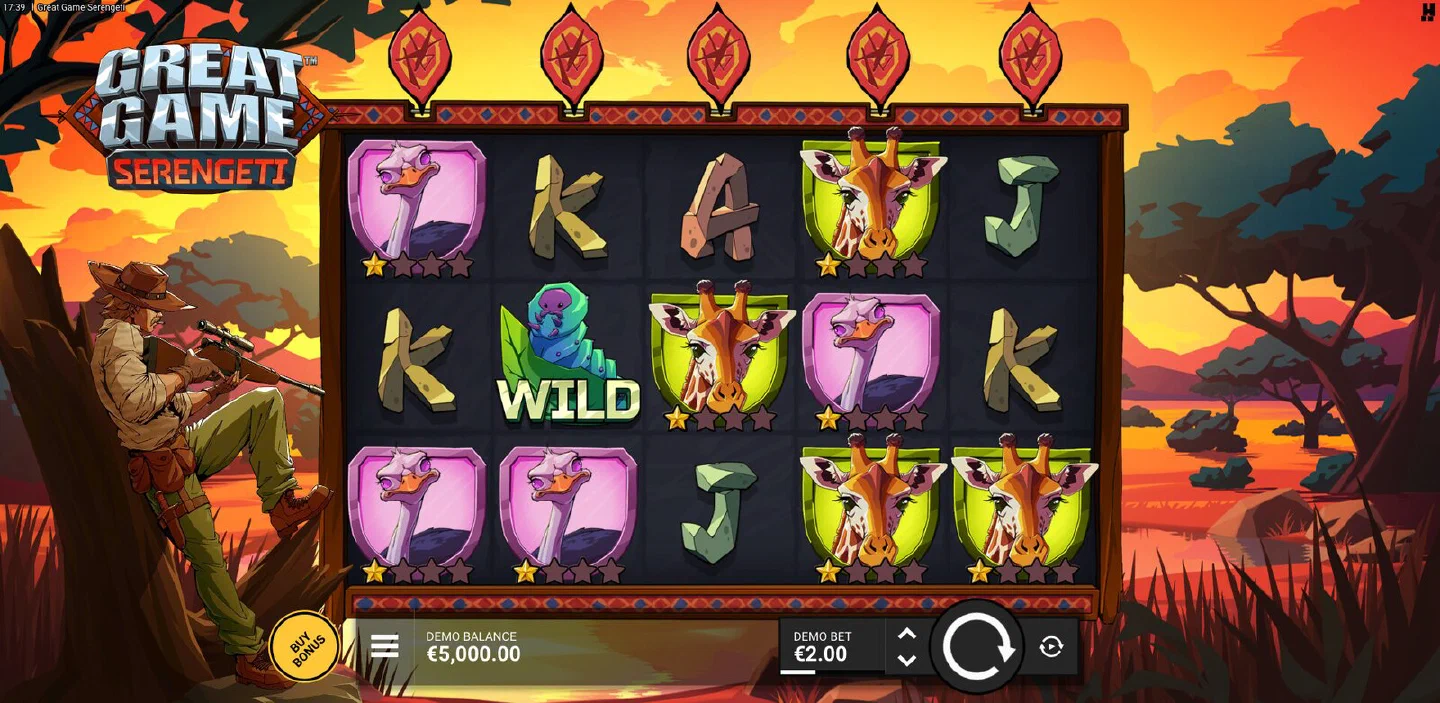
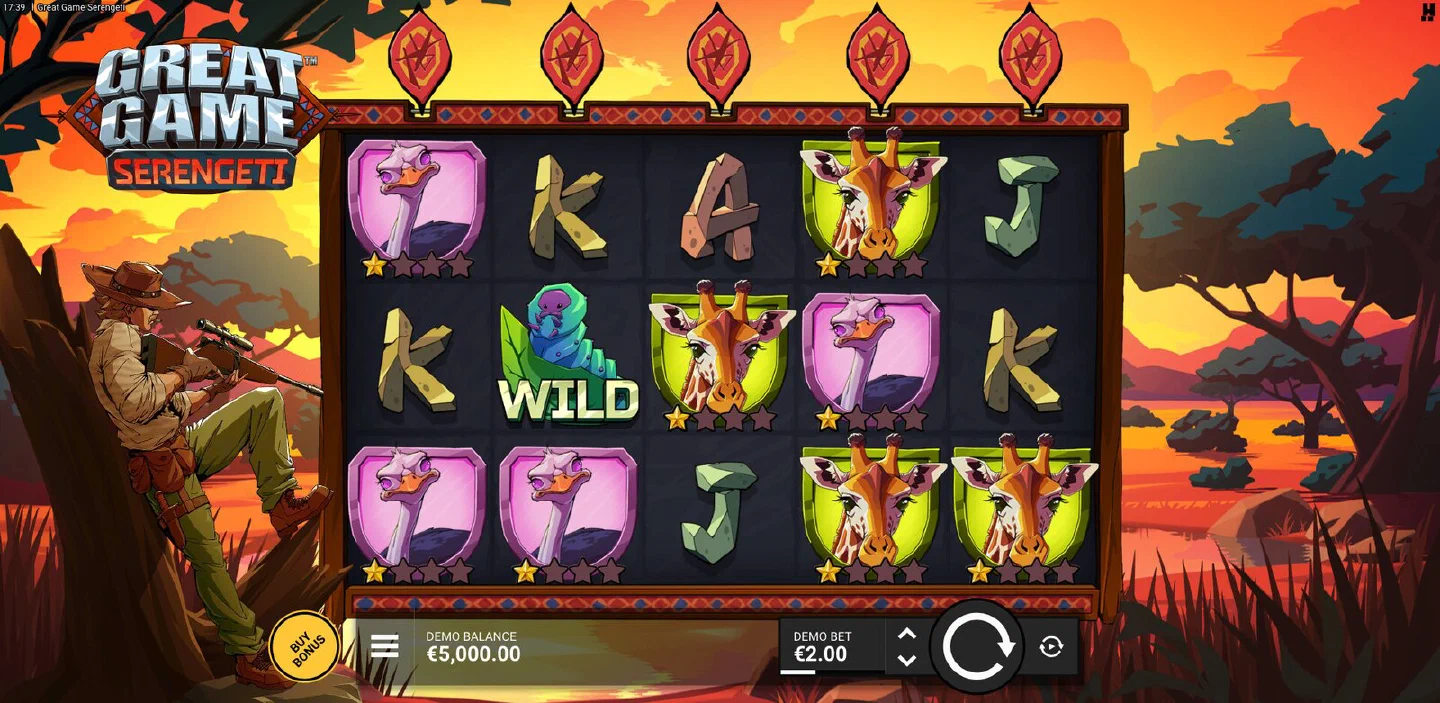
These two games come from the same studio and sit on the same frame: five reels, three rows, nine paylines paying left to right. That is unusual enough to be worth a comparison, because when the container is identical you get a clean look at two different answers to the same question, which is how a slot should turn a screen full of symbols into a payout.
Same frame, different collection#
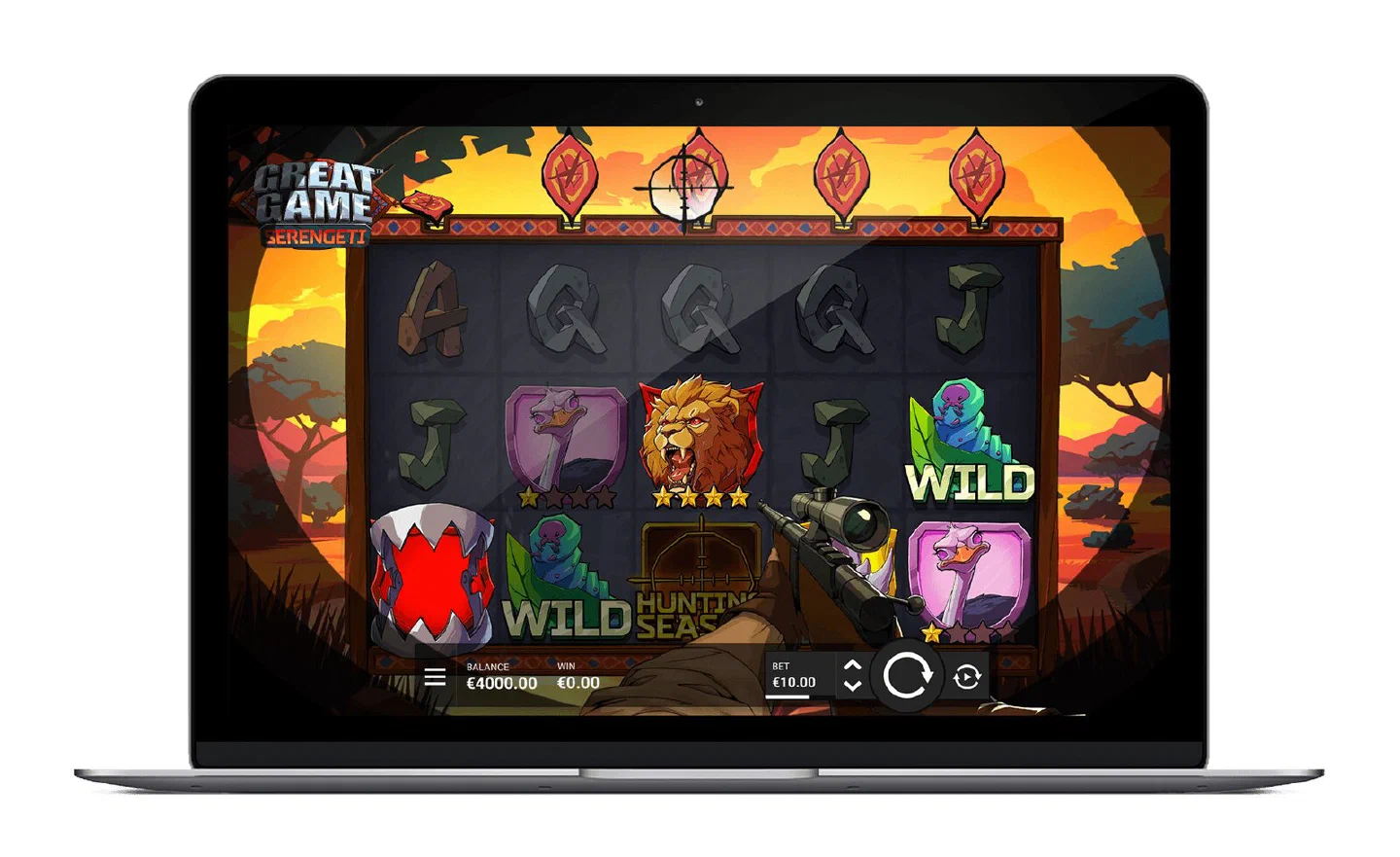
Great Game Serengeti collects by hunting. The line wins pay first, then a Hunting Season symbol fires five shots left to right at one target above each reel. Animals standing on the reels that were hit convert by star rank: one star to at least Bronze, two to at least Silver, three to at least Gold, and the four-star lion to a Trap. The Traps then collect the values of every Coin and every other Trap on the grid into one figure, and the round pays that total. It happens quickly, and the drama is in which reels the shots found.
Tres Pinatas Hold & Win collects by holding. Its Piñata Party is a Hold & Win round with three lives: symbols lock in place, and when the lives run out the green piñata collects the values on the grid and refills them. The tension is cumulative rather than instant, and the round has a shape you can watch developing over several respins.
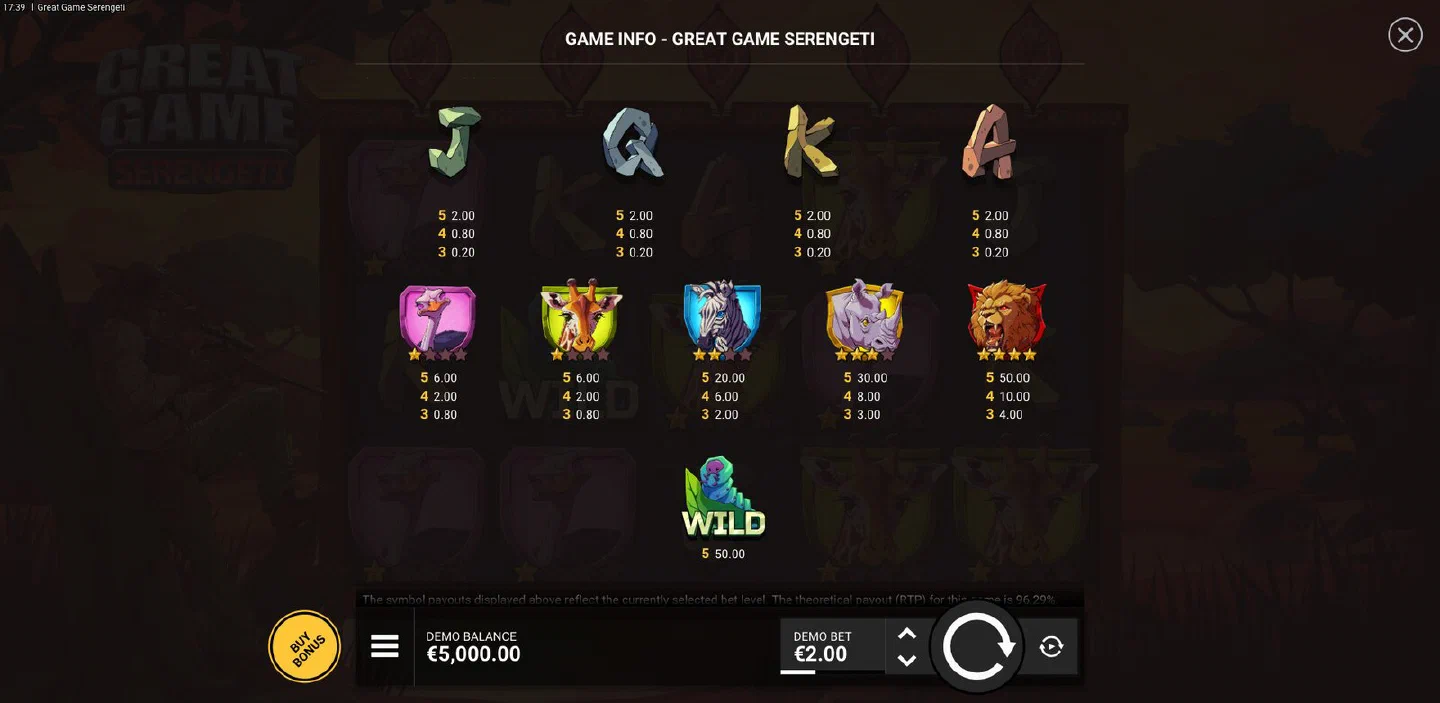
The other difference the frame hides is what the base game is for. In Serengeti the paytable keeps a steady beat underneath the hunt: the royals pay 0.1x to 1x the bet and the one-star animals 0.4x to 3x, so those rows are the funding rather than the point of the game. In a Hold & Win design the base game plays a similar role but the payoff arrives as a filled board rather than as a converted one, which changes how a flat stretch feels while you wait.
Neither approach is better in the abstract. A hunt rewards a good board in one motion, which suits a session where you are dipping in and out. A Hold & Win builds anticipation across a sequence, which suits sitting down with it. The features page has the full mechanical detail on the Serengeti side, including all three bonus rounds and the hidden Zebrawl.
The ceilings, priced on the same bet#
The round cap is where the two games separate, and it needs two readings rather than one. Priced on a stake both games offer, Serengeti’s ceiling is worth exactly double:
| Your bet | Great Game Serengeti at 5,000x | Tres Pinatas Hold & Win at 2,500x |
|---|---|---|
| 0.10 | 500.00 | 250.00 |
| 2.00 | 10,000.00 | 5,000.00 |
| 200.00 | 1,000,000.00 | 500,000.00 |
The second reading uses each game’s own bet ladder, and it changes the conclusion. Serengeti’s bet selector stops at 200.00; Tres Pinatas runs to 400.00. Price each game at its own maximum stake and the cash ceilings are identical: 5,000x on a 200.00 bet and 2,500x on a 400.00 bet are both 1,000,000.00. So neither game reaches higher than the other in money. What Serengeti’s larger multiplier actually buys you is the same top figure from half the stake, which is a real advantage at every rung below the cap and no advantage at all at the top of both ladders.
Two things are worth adding. The first is that Great Game Serengeti’s ceiling is available in every game mode, so bought rounds and earned rounds top out at the same height. The second is that a ceiling is a cap rather than a target, and the path to it matters as much as the number: here it runs through Diamond coins at 100x, 150x, 250x and 500x, a Trap that collects everything around it, and a Wild on a shot reel worth up to x20.
Getting in: two bets against five#
Both games sell entry to their feature, and the prices tell you something about how each one expects to be played.
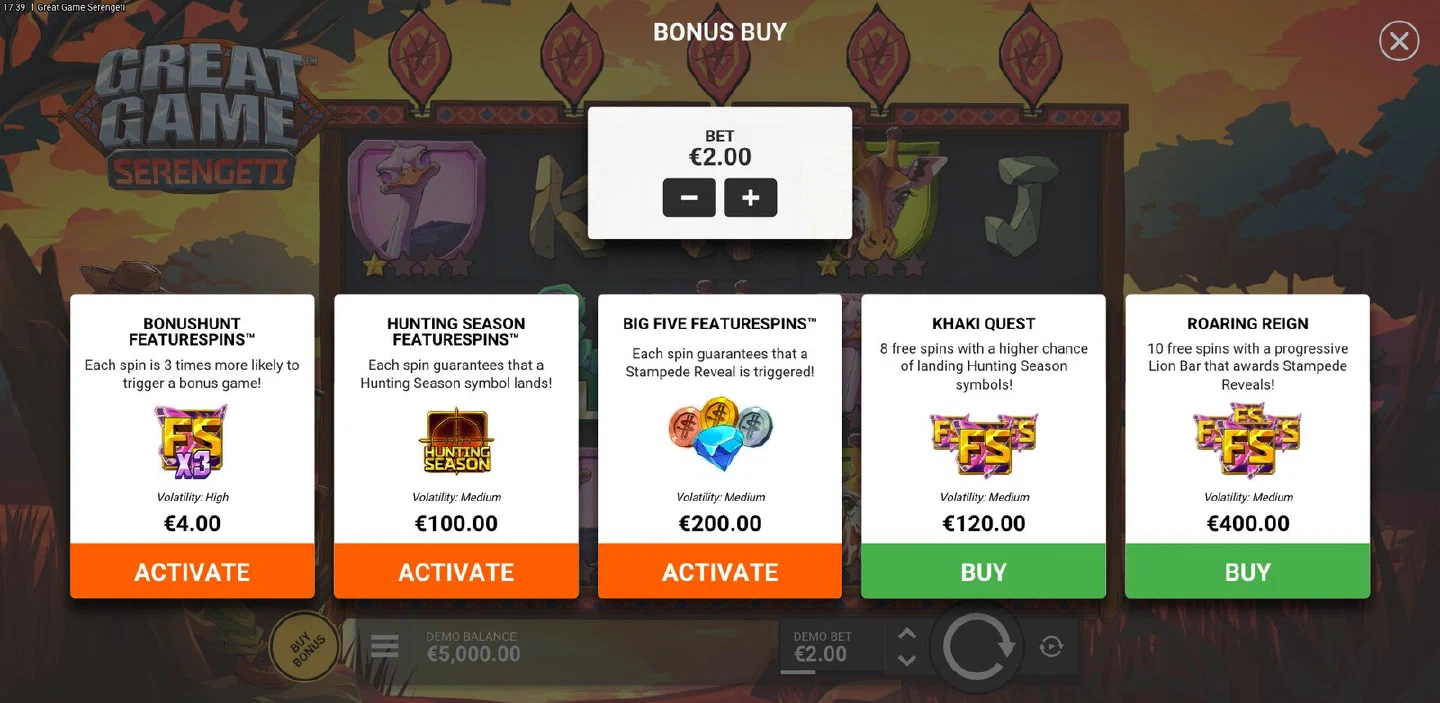
Great Game Serengeti offers five entries: BONUSHUNT FeatureSpins™ at 2x the bet, HUNTING SEASON FeatureSpins™ at 50x, KHAKI QUEST at 60x, BIG FIVE FeatureSpins™ at 100x and ROARING REIGN at 200x, with published returns of 96.35%, 96.23%, 96.1%, 96.26% and 96.31% respectively. At the 0.10 minimum stake the whole menu runs from 0.20 to 20.00.
Tres Pinatas starts its menu at 5x the bet for its BonusHunt FeatureSpins mode, with the Mini and Mega Piñata Party entries at 100x and 200x. At the same 0.10 stake those are 0.50, 10.00 and 20.00.
The shape of the two menus is similar at the top and different at the bottom. At the expensive end both games ask 200x for their fullest round, which is a price equivalent to 200 base spins at the same stake in either game. At the cheap end, 2x against 5x is a real gap: a rung you can leave switched on for a long stretch versus one you use more deliberately. If you like keeping a FeatureSpins mode running while you play, that difference compounds over a session. The strategy page works through the arithmetic on the Serengeti side.
What the entry price buys in each game#
Price is only half the comparison; the other half is what arrives when you pay. On the Serengeti side, the 2x entry is a FeatureSpins™ mode rather than a round: it stays switched on until you disable it, charges its price on every spin and makes a bonus three times more likely. The 60x and 200x entries are direct purchases that start Khaki Quest at eight free spins or Roaring Reign at ten, immediately. Those are two genuinely different products at two ends of one menu, and knowing which you are buying matters more than the price itself.
The same logic applies when you look across at the other game: a mode you leave running and a round you buy outright behave differently over a session even when the headline numbers look similar. A useful test before paying for anything is to ask how many times your own budget could repeat it. At the 0.10 stake a 200x round costs 20.00 in either game; at the 2.00 default the same round costs 400.00, twenty times as much for an identical feature. If the answer to “could I pay this three times tonight?” is no, the stake is the thing to change, not the entry.
Where the two are level#
It is worth being clear about what this comparison does not separate. The default returns are 96.29% and 96.26%, three hundredths of a percentage point apart, which is noise rather than an argument. Both sit at 3 of 5 on their provider’s volatility scale. Both start at 0.10 a spin. Both run nine paylines on a 5x3 grid, and both come from a studio that prices its features openly and names them properly.
That leaves the decision where it should be: on the shape of the round you enjoy and on the two figures that genuinely differ, the ceiling and the entry price. A useful habit when comparing any two slots is to check the return tier your specific table serves before you weigh anything else, since publishers often ship several configurations. Great Game Serengeti ships four, from 96.29% down, and the RTP page explains how to read which one you are on.
Reading the comparison table properly#
A note on how the table above was built, because comparison pages are easy to fudge. Every row carries a published figure from both games; any dimension where only one side publishes a value has been left out entirely rather than filled with a placeholder. That is why you will find grid, lines, return, ceiling, bet range at both ends, volatility step and cheapest entry there, and nothing else. The bet-range rows earn their place precisely because the ceiling row is meaningless without them.
It also means the table understates how much the two games differ, because the most interesting parts of each one are the parts the other does not have. On the Serengeti side that is the conversion by star rank, the four coin families running from 0.2x to 500x the bet, the Trap that gathers the grid into a single total and the Wild multiplier of up to x20. Those have no counterpart column, so they live in the prose instead.
The honest summary is that the shared measurements tell you these games are siblings, and the unshared ones tell you which sibling you would rather spend an evening with. Read both halves before deciding.
Who should pick which#
Pick Great Game Serengeti if the multiplier and the price of entry are what you are optimising for. Twice the round cap on any stake the two games share, plus a bonus entry at 2x the bet, is a combination built for smaller stakes and shorter sessions: it is the game that gives you the most for a 0.10 spin. The hidden Zebrawl round, opened by five FS symbols and absent from the buy menu, gives the base game a genuine reason to exist on top of that.
Pick Tres Pinatas Hold & Win if you prefer a collect round that builds, or if you play at the top of the ladder. A Hold & Win with three lives is a slower, more theatrical structure, and a hunt that resolves in seconds is a different pleasure. Its bet selector also runs to 400.00 against 200.00 here, which is why the two games finish level on cash at their respective maximums. That is a preference and a stake decision rather than a flaw in either game.
If you want to test the difference rather than read about it, the free demo runs the Serengeti side on practice credits with the full buy menu open. The slot hub carries the complete specification, and similar slots lines up the wider shortlist.
A final word on how to use a page like this. Comparisons are most useful before you have played either game and least useful after you have played both, since by then you already know which round you enjoy. If you are at the first stage, the fastest way through is to open each game on practice credits, trigger the feature once in each, and notice which one you were still watching at the end. The figures on this page will tell you what that preference costs; only the reels will tell you what it is.
18+. Two games, two sets of maths, and neither promises a session. Set the limit first, and the responsible gambling page shows how.